| |
 Hebrew Vocabulary
Exploring Praise and Worship
with the Names of God, Part I
Preface
The following article uses words (and spellings) taken from the Hebrew Old Testament. These spellings are in some cases considered rare and would not necessarily be used in a modern Hebrew setting. The spellings used in the Names of God table are taken from the devotional book Praying the Names of God: A Daily Guide by Ann Spangler. This book may be purchased through our online store. This article is meant to be used in conjunction with other methods of learning Hebrew and not as the sole method. For additional resources, visit our Hebrew Links and Resources page.
Praise
In our first article on praise and worship in Hebrew, we introduced words and phrases of praise and worship from Scripture. In this article, we will take some of those phrases and practice using them with some of the Names of God.
We began with the word   hee-lehl. Note: It is pronounced slightly differently depending on its usage. We learned how to say Praise God (hahl-loo yah), Praise God (hahl-loo-ehl), and Praise Him (hahl-loo-hoo). hee-lehl. Note: It is pronounced slightly differently depending on its usage. We learned how to say Praise God (hahl-loo yah), Praise God (hahl-loo-ehl), and Praise Him (hahl-loo-hoo).
Now, let's practice adding in different Names of God.

For more practice, a chart of Names will be provided at the end of this article, or visit the Hebrew Names of God page.
One of the challenges of learning Hebrew is memorizing verbs, very few of which bear any similarity to English words with a comparable meaning. One of the exceptions is a form of the word exalt is used in Psalm 145:1. Exalt is     rohmehm. The single word in Hebrew rohmehm. The single word in Hebrew  ahrohmeem'khah means I will extol (exalt) You. This is one of the few verbs in Hebrew that is at all reminiscent to an English word (aroma) that has a similar meaning. Consider the meaning of aroma in these passages: ahrohmeem'khah means I will extol (exalt) You. This is one of the few verbs in Hebrew that is at all reminiscent to an English word (aroma) that has a similar meaning. Consider the meaning of aroma in these passages:
For we are to God the aroma of Christ among those who are being saved and those who are perishing. To the one we are the smell of death; to the other, the fragrance of life. And who is equal to such a task? �2 Corinthians 2:15-16 (NIV)
I have received full payment and even more; I am amply supplied, now that I have received from Epaphroditus the gifts you sent. They are a fragrant offering, an acceptable sacrifice, pleasing to God. �Philippians 4:18 (NIV)
Let's practice this word with the three Names of God presented earlier.

In Psalm 7:17, the word   ohdeh is used to praise God, taken from the word ohdah, which means to thank. So, in this verse the praise of God takes the form of thankfulness. ohdeh is used to praise God, taken from the word ohdah, which means to thank. So, in this verse the praise of God takes the form of thankfulness.
Let's practice this form of the word praise with the three Names of God presented earlier.

In the same verse, the Psalmist says he will sing praise to the Name of the Lord. Here the word used is derived from the word to sing  zeemehr. zeemehr.
Let's practice this form of the word praise with the three Names of God presented earlier.

Bless the Lord
The three letters that make up the root word for the verb to bless are  (behrehkh) however, depending on the usage of the word, the "b" sound can often take on a "v" sound. So in the sentence I will bless the Lord, bless (beh-rehkh) becomes I will bless (ah-vah-rah-kah). The important thing to note is the presence of the three root letters . [Remember kaf (behrehkh) however, depending on the usage of the word, the "b" sound can often take on a "v" sound. So in the sentence I will bless the Lord, bless (beh-rehkh) becomes I will bless (ah-vah-rah-kah). The important thing to note is the presence of the three root letters . [Remember kaf  and kaf sofit and kaf sofit  are the same letter. The kaf appears in the middle of the words, the kaf sofit is used at the end of a word.] are the same letter. The kaf appears in the middle of the words, the kaf sofit is used at the end of a word.]

Closing Thoughts
We hope this introduction to practicing the Hebrew words for praising and worship with the Names of God will be a springboard for future study of the Hebrew language. Whether you are studying in order to search for Bible codes, or to enhance your times or praise and worship, we hope that the knowledge of the richness of the Hebrew language will add significance to your life and studies.
   
References
All Scripture references in Hebrew and English, unless otherwise noted, were taken from Keys to the Bible.
Scripture quotations marked "NIV" are taken from the HOLY BIBLE, NEW INTERNATIONAL VERSION�. NIV� Copyright �1973, 1978, 1984 by International Bible Society. Used by permission of Zondervan. All rights reserved.
Ben-Yehuda and Ben-Yehuda. 1964. Ben-Yehuda's Pocket English-Hebrew/Hebrew-English Dictionary New York: Simon & Schuster, Inc.
Green Sr., Jay P. 1986. The Interlinear Bible: Hebrew-Greek-English Lafayette, Indiana: Sovereign Grace Publishers.
Mechon-Mamre.org The Mechon-Mamre.org site has a Hebrew-English Bible (Tanakh only) according to the Masoretic text and the JPS 1917 Edition. This site has MP3 recordings of the text.
For additional Hebrew language resources, visit our Hebrew Links and Resources page.
Names of God
The following list is derived from the devotional book Praying the Names of God: A Daily Guide by Ann Spangler. This book may be purchased through our online store.
The following list is by no means comprehensive, but lists 26 of the most prominent Names of God.
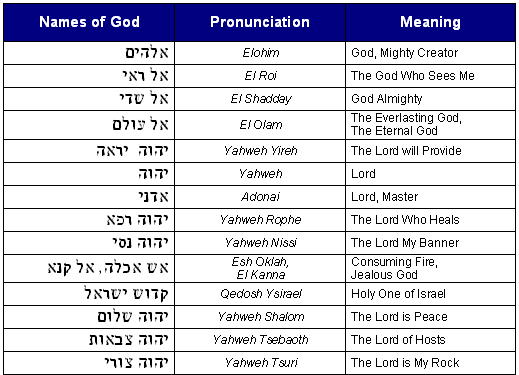
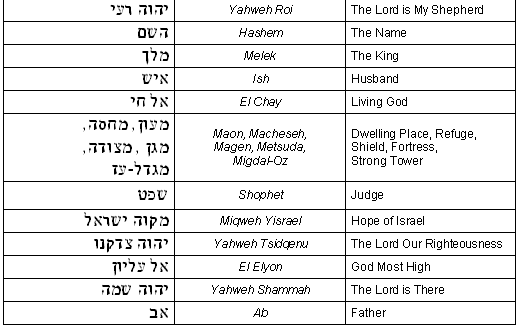
|
Enjoy finding your own Bible codes.
Bible code search software is available in our online store.
Subscribe Free! Sign Up Today!
Become a member of the non-profit Isaac Newton Bible Code Research Society.
Not only will you be part of the world's leading organization researching and publicizing Bible and Torah codes, but you will receive Bible Code Digest absolutely free, including . . .
- Latest Bible Code News
- Easy-to-Understand Bible Code Feature Articles
- Exciting Inside Information from Leading Code Researchers
- Details of Great New Discoveries
- Summaries of the Latest Battles Between Code Proponents and Skeptics
Stay current on Bible code news. Be first to hear about all of the latest Bible code discoveries.
Sign up to receive Bible Code Digest today.
|
|


Bombshell examines two massive, recently discovered clusters of codes in the Hebrew Old Testament. To read more about Bombshell, click here, or click below to order from Amazon today!

|



